
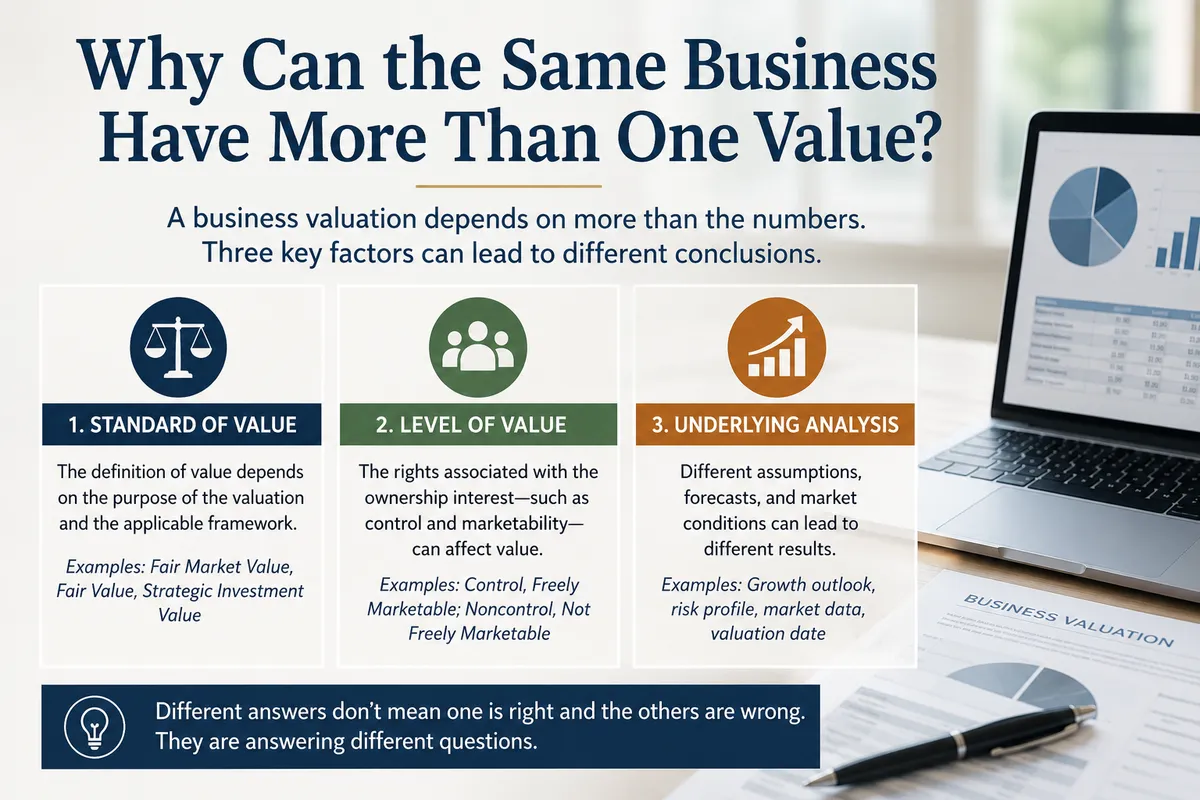
Why Can the Same Business Have More Than One Value?
Why Can the Same Business Have More Than One Value?
If you've ever heard two professionals discuss the value of the same business and arrive at different conclusions, you may have wondered how that can happen. After all, shouldn't a business have one value?
It's a reasonable question, but business valuation isn't quite that simple.
In reality, there often isn't a single value that applies in every situation. A business may have different values depending on why the valuation is being performed, what ownership interest is being valued, and the assumptions that apply to the engagement.
That doesn't mean one valuation is "right" and another is "wrong." It means they're answering different questions.
Understanding that distinction is one of the first steps toward understanding how business valuation works.
Valuation Begins with the Right Question
When someone asks, "What is my business worth?" a valuation professional usually needs additional information before beginning the analysis.
For example:
Why is the valuation being prepared?
What ownership interest is being valued?
What rights are associated with that ownership interest?
What information was available on the valuation date?
Each of these questions helps define the assignment before any financial analysis begins.
An analogy may help illustrate the point.
Imagine asking, "What is a house worth?" The answer could depend on whether you're discussing the price a buyer might pay in today's market, the amount needed to rebuild the home for insurance purposes, or the value assigned for property tax assessment. The house hasn't changed, but the purpose of the valuation has.
Business valuation works in much the same way.
The Standard of Value
One of the most important concepts in any valuation engagement is the standard of value.
Simply stated, the standard of value defines what kind of value is being measured.
Different engagements may require different standards of value depending on the facts and circumstances. Some of the more common standards include:
Fair Market Value
Fair market value is one of the most frequently encountered standards in valuation engagements.
Although the precise legal definition depends on the applicable authority, it is generally intended to estimate the price at which a business or ownership interest would change hands in a hypothetical transaction between a willing buyer and a willing seller, with both parties being appropriately informed and neither being under any compulsion to buy or sell.
This standard is commonly encountered in tax-related valuations and many other types of engagements.
Fair Value
The term fair value is used in several different contexts, and its meaning depends on the purpose of the engagement.
For example, fair value in a financial reporting context may differ from fair value under a state's corporate law governing shareholder disputes. Because the applicable definition varies, it is important to understand which definition applies in a particular engagement.
Strategic Investment Value
Investment value considers the value of a business to a particular investor or class of investors.
Unlike fair market value, which generally assumes hypothetical market participants, investment value recognizes that a specific buyer may expect unique benefits from owning the business. Those benefits could include operational efficiencies, strategic advantages, or opportunities that are not available to other market participants.
As a result, investment value may be higher or lower than fair market value depending on the circumstances.
The Standard of Value Helps Define the Assignment
These standards are not competing opinions about what a business is worth.
Instead, they answer different questions.
Suppose one valuation is prepared for gift tax planning using fair market value, while another is prepared by a strategic buyer evaluating an acquisition opportunity. Even if both analyses are performed on the same day using the same financial information, they may appropriately reach different conclusions because they are measuring different concepts of value.
Understanding the applicable standard of value helps ensure that the valuation conclusion is interpreted in the proper context.
Standards of Value Are Only One Piece of the Puzzle
Even after the appropriate standard of value has been identified, additional questions remain.
For example, are we valuing the entire company or a noncontrolling ownership interest? Can the ownership interest be readily sold, or is it an interest in a privately held company with limited marketability?
These characteristics can also influence value because they affect the rights associated with the ownership interest being appraised.
In other words, identifying the correct standard of value is an important step, but it is not the final step.
Looking Ahead
In future articles, we'll explore two additional concepts that often affect business valuations.
First, we'll discuss levels of value and how control and marketability influence the value of an ownership interest.
We'll also examine valuation discounts—what they are, why they exist, and why they should not be viewed as arbitrary reductions in value.
Together, these concepts help explain why business valuation is more than applying a formula. It is a process of analyzing the specific ownership interest, the purpose of the engagement, and the economic realities that surround both.
Understanding the Context Behind the Number
At C5 Business Advisors, we believe a valuation should provide more than a conclusion of value. It should help clients understand the assumptions, purpose, and context behind that conclusion.
Whether you're planning for a business transition, evaluating an ownership transfer, or simply trying to better understand your company's value, beginning with the right questions helps ensure the valuation is appropriate for your specific objectives.
If you're considering a business valuation, we welcome the opportunity to discuss your objectives before the engagement begins. Understanding the purpose of the valuation is one of the first steps toward developing an analysis that is meaningful, well-supported, and tailored to your needs.